
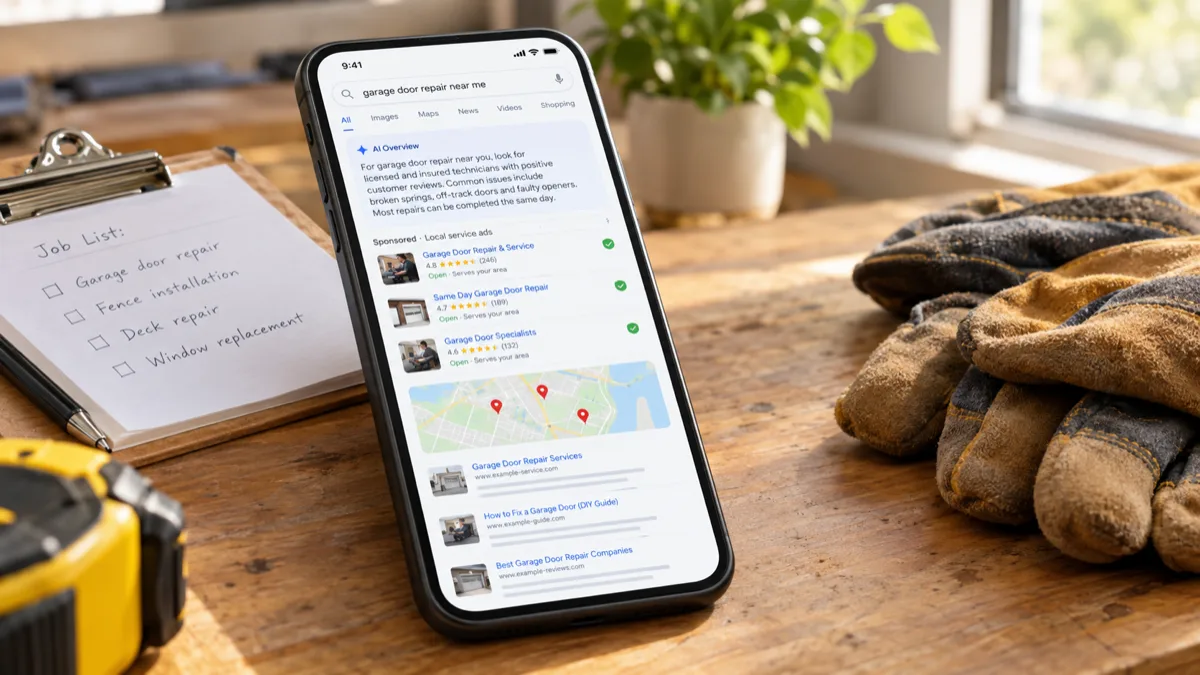
If you run a local service business, the moment a customer types a need into Google is the moment you get found or skipped. It's where 87% of people go to find a local business. But a lot of owners haven't caught up to what actually comes back now. "First page of Google" used to mean a tidy list of ten website links, and ranking at the top meant you won. That page is gone.
So let's walk through what the page looks like tonight, top to bottom, and what SEO really means in 2026 for a local business that lives on Google.
The search results page, top to bottom
Type "water heater repair San Luis Obispo" into a phone and you'll get something like this, in order:
1. An AI answer, sometimes. For a growing share of searches, the page opens with a written answer Google's AI puts together before anyone clicks anything (Google calls these AI Overviews). In July 2025 they told investors these answers reach 2 billion people a month, up from 1.5 billion two months earlier. Nothing sits above it.
2. Local Service Ads. A row of businesses with star ratings, a phone number, and a green Google Verified checkmark, at the very top of the paid stack. These businesses pay per lead, a real call or message, not per click. Most local trades are eligible categories, and the screening checks your license, insurance, and background where your trade requires it. For a stranger deciding whether to let you into their house, that badge doubles as a character reference. (Google renamed the badge in October 2025 and dropped the old money-back promise.)
3. Regular Google Ads. The Sponsored text listings. You pay every time someone clicks, whether they call you or leave after five seconds.
4. The map. Three local businesses with pins, star ratings, hours, and a call button, built straight from their Google listings, usually with a sponsored spot tucked inside. On a "near me" search from a phone, this is the first thing that feels like an actual answer.
5. The regular website listings. The classic blue links, what SEO people call the organic results. This is what "first page of Google" used to mean. On a phone, the first website link can sit two full screens down.
Where do customers actually click? In one survey of Google searchers, about 41% said they'd click a map result, about 29% the local service ads, and only 11% the regular text ads. The parts of the page people actually use are the AI answer and the map.
So what does SEO mean now?
For years, SEO meant climbing those blue links toward the top. That's still real, but it's no longer the main event. The honest way to read the 2026 page: the top is rented, the rest is earned.
Ads rent the top. They start working the day you pay and stop the day you don't. The map and the website listings can't be bought at any price. Google fills them from two things you actually own: your Google Maps listing (the local half of SEO) and your website (the on-site half). Anything real you can do about search lives in those two places.
And they matter more every year, because clicks are getting scarce. In a 2024 study of real search behavior, 58.5% of American Google searches ended without a click at all, and for every 1,000 searches, only 360 clicks ever reached an independent website. When the AI answer or the map answers the customer's question on the spot, the business named there wins the moment without a click. Your listing, your hours, your star rating are talking to customers even when nobody visits your site.
So doing SEO in 2026 comes down to two jobs. Make your Google listing complete, verified, and well reviewed. And make your website easy for Google, and its AI, to read, understand, and trust. Neither job is mysterious. Both take the work most of your competitors skip.
Local SEO: the Google Maps listing half
The map doesn't pick businesses at random. It's built from Google Maps listings (Google calls them Business Profiles), and the first gate is verification: an unverified business doesn't show up at all. After that, Google says it ranks local results on three things: relevance, distance, and prominence. In plain words: does your listing match the search, how far away are you, and how well known are you, which is mostly reviews plus what the rest of the web says about you.
Completeness does real work in that ranking. In one study of two million listings, 75% of the businesses in the top three map spots had a completed description; below 11th place, fewer than 40% bothered. And local search experts agree your primary category is the single biggest local ranking factor. "Plumber" gets found. "Home services" mostly doesn't.
It pays because of how customers search: 86% of all Google Business Profile views come from category searches like "landscaper near me," not searches for a business name. They find you by what you do long before they know your name.
Then reviews. 97% of consumers read reviews for local businesses, and nobody reads them harder than somebody picking a stranger to let into their house, their yard, or their hair. Ask your happy customers (here's how, without begging) and reply to what they write. A business that answers its reviews reads like a business that answers its phone.
Doing it is an afternoon: get verified, pick the specific category, fill every field, list your services, set real hours, add real photos of your work and your crew, name the towns you cover. We have a setup guide and a 2026 tune-up guide for the walkthrough. Most of your competitors are half done; completeness is the opening.
On-site SEO: the website half
The blue links still matter. What your website says feeds the map ranking too, and the listings themselves are where the serious vetting happens once a parent is down to two or three names.
Stripped of jargon, on-site SEO is:
- Titles and descriptions that say what you do and where. "Water heater repair in Templeton" gets clicked and ranked. "Quality service you can trust" gets neither.
- One clear page per service you offer, so "panel upgrade in Grover Beach" matches a page that's actually about that.
- Your name, address, and phone written exactly the same everywhere, on the site and across the web.
- Pages that load fast on a phone, because that's the screen the parent is holding.
- A sitemap, so Google finds every page you have, not just the homepage.
- Plain text and honest headings. If a person can skim it, Google's AI can read it, summarize it, and name you in an answer. Vague fluff is invisible twice.
Notice what's not on the list: tricks. There's no keyword magic, and none of this needs a monthly mystery fee. It's craftsmanship at build time, plus keeping what's there current when your schedule, prices, or openings change.
And when a customer finally clicks through, the old ten-second test still decides everything: do you do what I need, are you qualified and reviewed, what does it cost, are you actually nearby, do other customers trust you. The search page earns you the look. The website earns you the call.
Where ads fit in, honestly
Ads aren't cheating. For a slow month, a new hire, or a seasonal push, they're the fast lane, and speed is the point of a fast lane. Most local trades qualify for the Local Service Ads at the very top, where you pay per lead instead of per click. In one dataset from over a hundred businesses, real leads ran about $30 to $80 each in most service categories. Regular Google Ads cost per click and can buy the exact searches the map and the blue links can't win for you yet.
The honest trade: ads are rent, and they stop the day the budget stops. The listing and the website are what you keep, so they come first. Claim and complete the Google listing, get the website right, build reviews steadily, then decide whether renting the top is worth this season's push. If you want the full picture on the pay-per-lead option, here's our plain-language guide to Local Service Ads, including which businesses qualify.
What YouGrow Does Differently
That two-job version of SEO is exactly how we work. Every website we build comes with the on-site half done properly: titles, descriptions, sitemap, and the search basics, built so search engines and AI tools can read your business clearly. It's part of the $99 a month, not a line item. Nothing extra to start, month-to-month, and when your hours, prices, or services change, those changes are part of the service too.
The local half is our Get Found service: we set up and verify your Google Maps listing, keep it complete and current, and help you answer reviews and ask your customers for them, starting at $49 a month. One honest disclaimer: nobody can promise you a top-three spot on the map, and we'd be suspicious of anyone who does. What we can do is keep the basics accurate, active, and consistent, which is precisely what Google says it rewards.
And if you want the top of the page while the earned half grows, we manage Google Ads too, with a free viability check first. If the numbers don't work for your business, we'll tell you not to run them.
Want to see what tonight's search page looks like for your business, and what it would take to climb it? Ask us for a free custom mockup, or call 805-439-6288 and talk it through. We're in Arroyo Grande, and we're happy to come to you.